
How Sellable Is Your Business?
Take the free Exit Readiness Scorecard and get a personalised report on how ready your business is for a successful sale.
Score Out of 100
Get a clear, quantified picture of where your business stands
5 Key Categories
Owner independence, financials, market position, operations, and strategic value
Suggested Priorities
Specific recommendations based on your answers to improve your exit readiness
25 questions • Five preparation categories • Free with email access
“The businesses that sell for the best prices are the ones that prepared years in advance. This scorecard tells you exactly where to focus.”
– Adam J. Graham, author of Exit Mode
Understand your exit readiness
Is your business ready to sell?
A profitable business is not automatically easy to transfer. Buyers also need to understand who runs it, how reliable the numbers are and what could change after the founder leaves. The Exit Readiness Scorecard helps you identify preparation gaps before they become questions in a sale process.
This free self-assessment contains 25 questions across five categories. Enter your email to access the tool. You receive an overall score, a category breakdown and suggested priorities based on your answers. It is a planning aid, not a valuation, buyer assessment or prediction that your company will sell.
What the assessment measures
Owner Independence
Can the team operate, make decisions and maintain customer relationships without you?
Financial Health
How consistent are earnings, reporting, recurring income and customer diversification?
Market Position
What differentiates the business, and how defensible is that position?
Operational Readiness
How prepared are systems, employee arrangements, supplier relationships and responsibilities?
Strategic Value
What might a buyer be able to develop, and how prepared are you for a transition?
Answer against evidence you could explain to someone outside the company, not the improvements you intend to make. If you are unsure, note the missing information and investigate it with the relevant member of your team.
How your score is calculated
Each answer scores from 1 to 5. The overall score is the sum of your 25 answers divided by 125, multiplied by 100 and rounded to a whole number. Each category uses its five answers divided by 25. Questions and categories have equal weight.
Because the lowest answer is 1 rather than zero, a completed assessment can score from 20 to 100. A score of 60 means 60 out of the available 100 points in this framework. It does not mean a 60% chance of selling, a valuation discount or a comparison with other founders.
| Score | Label | How to use it |
|---|---|---|
| 20–30 | Early Stage | Identify the most basic preparation gaps. |
| 31–50 | Building Foundations | Choose a small number of weaknesses to address first. |
| 51–70 | Getting Ready | Strengthen the evidence behind your answers. |
| 71–85 | Near Ready | Test the remaining assumptions with your team and advisers. |
| 86–100 | Exit Ready | Treat this as a strong self-assessment, not independent approval. |
These are framework labels, not externally validated sale-readiness thresholds. A high total can still conceal one important weakness.
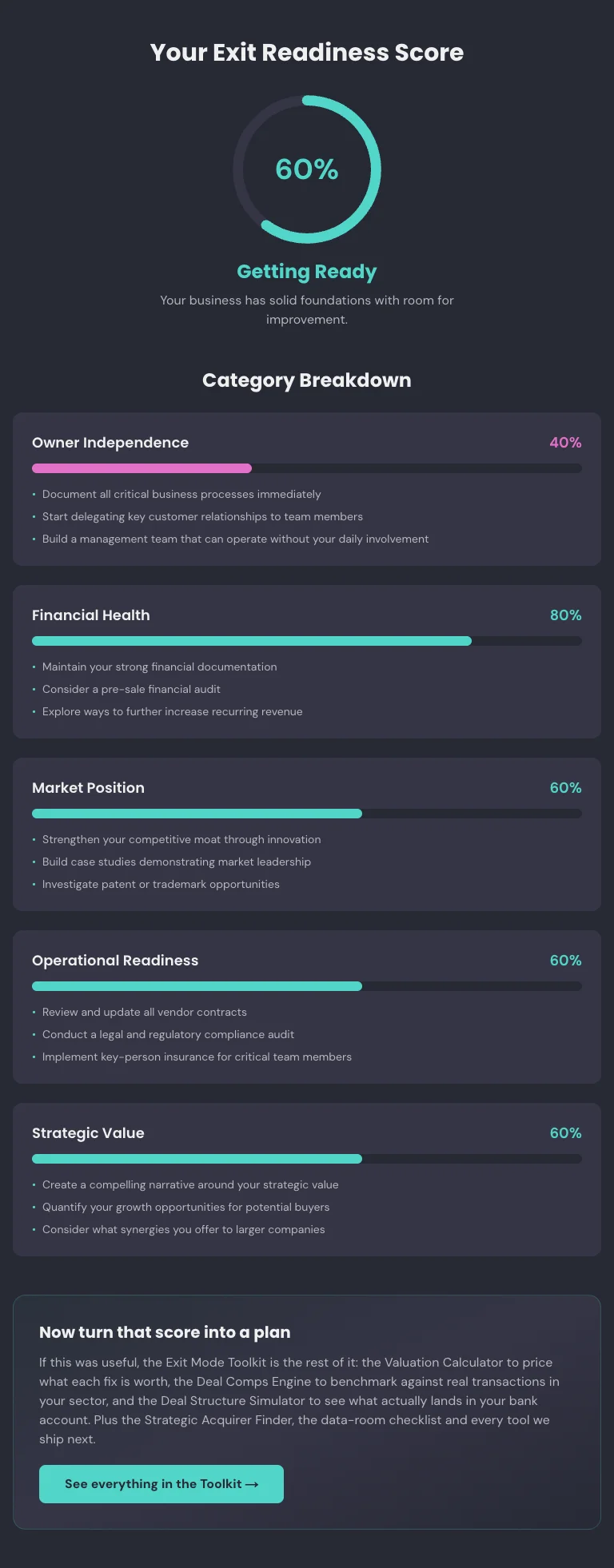
An illustrative result: 60 overall, 40 for owner independence
Suppose a hypothetical founder scores 75 points across all answers. The tool reports 60 overall. If their owner-independence answers total 10, that category scores 40. Those are illustrative inputs, not a customer result.
The useful next step is not to chase a higher total by answering more generously. It is to investigate the dependency: which decisions, relationships or processes still sit with the founder? Assign one improvement, an owner and evidence of progress. Read the owner-independence guide for a practical starting point.
Turn the result into a preparation plan
- Review the weakest category and the evidence behind each answer.
- Choose a manageable action, with a named owner and review date.
- Discuss legal, financial or tax-specific issues with qualified advisers.
- Repeat the assessment after meaningful changes and compare the supporting evidence, not just the score.
Use the 12-month sale-preparation guide to organise the work. If you first need to understand your ownership options, start with business exit strategy.
Questions about the Scorecard
Is this the same as a business valuation?
No. It assesses your answers about preparation. It does not calculate a sale price. The valuation calculator explores indicative value using separate inputs and assumptions.
Do I need to be selling now?
No. You can use it to identify work worth doing before choosing an exit date. If a sale is already under way, it can help organise questions, but it is not a substitute for transaction advice.
Does a high score mean a buyer will accept my business?
No. Buyers carry out their own diligence and have different requirements. Your answers are not independently verified, and the framework cannot capture every commercial, sector or regulatory risk.