
Business Valuation Calculator
Get an honest, multi-driver valuation of your business across 9 real-deal factors. Enter your email to unlock the free calculator.
How this business valuation calculator works
The calculator estimates an operating-business value using a sector starting multiple and nine additive adjustments. It then subtracts net debt to estimate equity value. You can use GBP, USD or EUR, but the calibration is UK-oriented; changing currency does not turn it into a local US or European market model.
The nine drivers are business size, customer concentration, growth, owner dependency, recurring revenue, gross margin, competitive advantage, geographic concentration and business stage. Each adds or subtracts from the starting multiple. The combined adjustment is capped between a 70% reduction and a 45% increase. Those are model boundaries, not statistical confidence limits.
The sector starting points range from 3.8× to 7.5× EBITDA in the current model. They are assumptions informed by historical UK and Ireland mid-market research and conservative model choices, not verified current UK SME sale ranges. Smaller businesses receive a separate size adjustment. See the sector assumptions and limitations before using an unadjusted multiple.
Normalised EBITDA and the revenue fallback
The earnings input is EBITDA plus the adjustment you supply. Support every adjustment with evidence, including any replacement cost for an underpaid founder. Read the EBITDA add-backs guide to avoid counting personal benefit as transferable profit.
If normalised EBITDA is not positive and above 5% of revenue, the tool uses a sector revenue-multiple fallback instead. Revenue does not establish profitability or cash generation. A thin-margin or loss-making result needs especially careful review; this fallback is a rough modelling aid, not proof a buyer will pay that amount.
What the result means
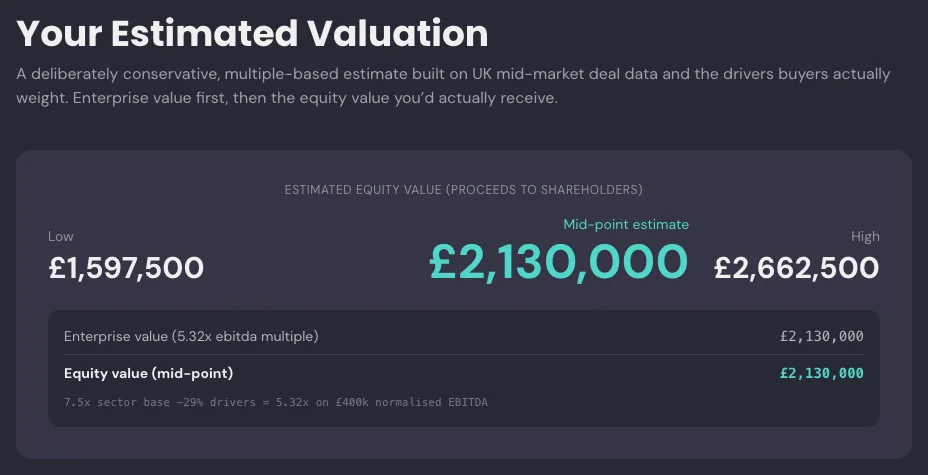
The tool shows a midpoint and an illustrative range of 25% either side of equity value, widened to 30% for the revenue fallback and floored at zero. It is a sensitivity band, not a measured probability interval. A real offer can fall outside it.
The simplified bridge subtracts net debt. It does not model every debt-like item, working-capital target, fee, tax consequence, earn-out or minority-interest adjustment. Equity value is not automatically cash you personally receive. Use how much is my business worth? for the proceeds bridge.
A worked example
Assume a hypothetical professional-services business with £1.5m normalised EBITDA and a neutral combined driver adjustment. The model’s 5.5× sector starting point gives £8.25m enterprise value. Subtracting £500,000 net debt gives £7.75m indicative equity value. The illustrative 25% band is approximately £5.81m–£9.69m.
This example explains the arithmetic, not a market offer. A smaller company, a different driver profile or an unsupported earnings adjustment changes the answer. No multiple is inferred from an undisclosed archive deal.
What the deal archive adds
Named transactions help you identify buyer types, strategic rationale and disclosed structure. They are not automatically like-for-like comparables. The Market Rocket announcement, for example, illustrates a management route but does not provide a matched price-and-earnings benchmark in our snapshot. Check the original source, transaction status and price basis.
When to get a formal business valuation
Use a qualified professional for a material transaction, tax purpose, shareholder dispute, litigation or financial-reporting requirement. Agree the purpose, basis and date. An automated estimate cannot inspect contracts, validate accounts or assess every risk a particular buyer sees.
For a deeper method comparison, read how to value a business. To prepare for a sale, use the business exit strategy guide and readiness scorecard.
Business valuation calculator FAQs
How do I figure what my business is worth?
Start with sustainable earnings and an appropriate method. Check a relevant multiple or other valuation basis, then account for debt, cash, working capital and deal structure. The calculator gives an indicative range, not an offer.
Is a business worth 3 times profit?
There is no universal three-times rule. EBITDA, net profit and seller’s discretionary earnings are different measures. Size, revenue quality, management and risk affect the appropriate valuation basis.
What are common valuation methods?
Common approaches include earnings multiples, revenue multiples in suitable cases, asset-based valuation and discounted cash flow. Use the method that fits the business and cross-check assumptions.
Is the business valuation calculator free?
Yes. Enter your email to access the free calculator. The methodology on this page is open to read without an email. The result is indicative and is not a formal valuation.
Written by Adam J. Graham, twice-exited founder and author of the Exit Mode business books. General educational guidance, not a formal valuation or personal tax advice.